What Is a Fleet Tracking System? Features, Benefits, and How to Choose

Managing a fleet means juggling maintenance schedules, regulatory compliance, and a budget that shifts every time fuel prices move. Those tasks are manageable. The harder problem is operational visibility, meaning knowing where your vehicles are, how they are being used, and whether your drivers are operating safely and efficiently.
Real-time visibility ensures you manage your fleet as effectively as possible, whether that means responding to an urgent customer call or re-routing around a traffic jam. This is the primary reason businesses invest in a fleet tracking system. Without one, operations leaders are always reacting to problems rather than preventing them.
When operations leaders lack live data, every decision is made with incomplete information. A fleet GPS tracking system changes that by giving you a continuous, accurate view of your entire operation. If you want the mechanics first, our guide to how fleet GPS tracking works breaks down the hardware, the data, and the software behind it. It also reduces the burden of manual administrative tasks, and in many cases automates them entirely.
If your business operates even a small fleet, this guide explains exactly what a fleet tracking system does, which features drive real ROI, and how to choose the right platform for your operations.
What a Fleet Tracking System Does: Core Features and Daily Use Cases
A fleet tracking system delivers value through several core capabilities. The following features represent what the technology does in practice, not just on a spec sheet:
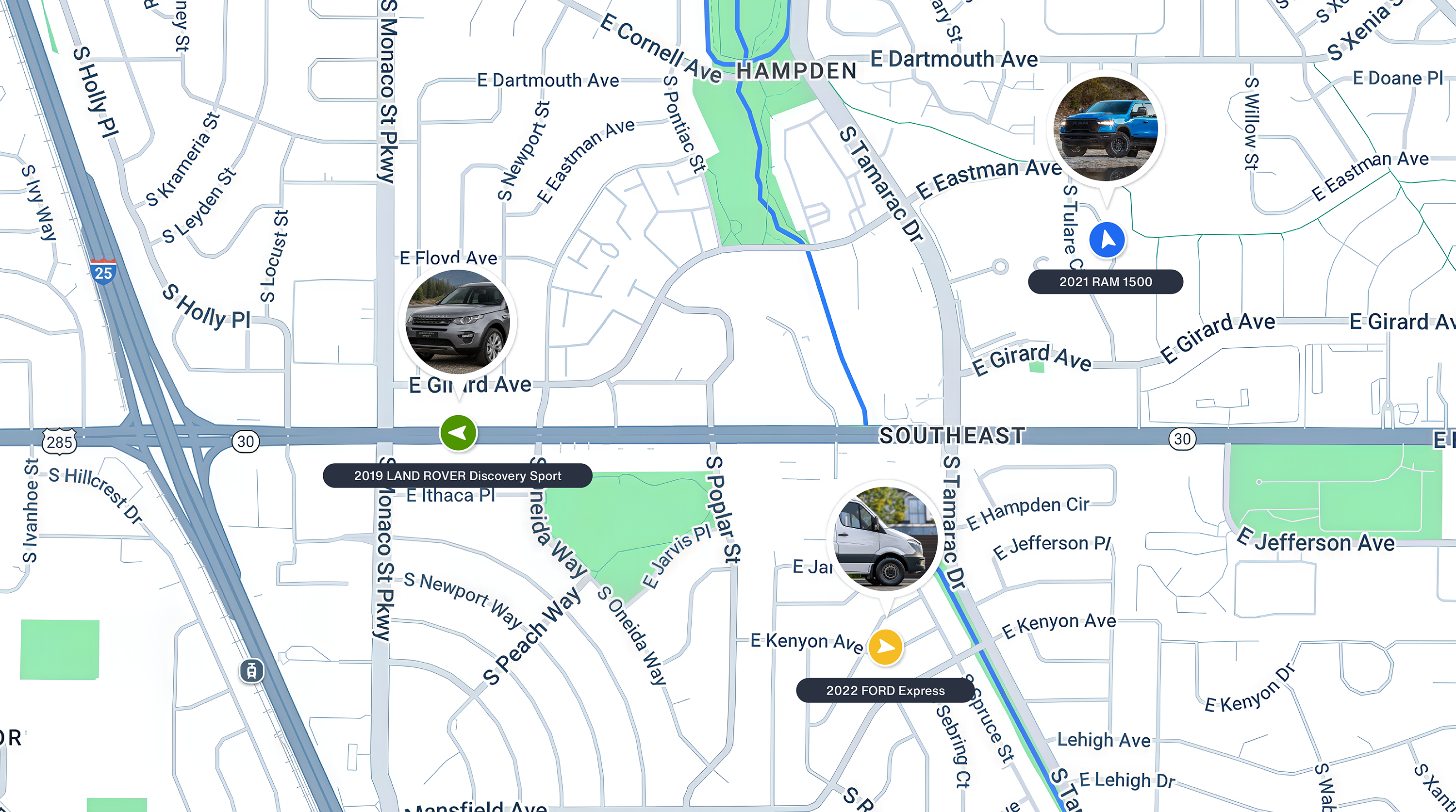
Real-time GPS tracking: The defining feature of any fleet tracking system is live location visibility. A GPS tracking device installed in each of your fleet vehicles transmits data directly to your fleet management HQ via the cloud. You can see exactly where all your company vehicles are at all times. You can use this continuous visibility to provide customers with more precise ETAs and respond more effectively to emergencies or changing traffic conditions.
Trip history: The fleet tracking software maintains a record of every route traveled. You can review past trips to identify the delays or unauthorized detours that increase wear and tear on your vehicles.
Usage and idle time tracking: Fuel is likely your largest fleet expense after labor costs, and it's highly variable. Tracking engine idle time and overall usage lets managers pinpoint waste, since a vehicle idling even 30 minutes a day burns fuel with zero operational output. Industry estimates put excessive idling at up to half a gallon per hour, so a fleet of ten vehicles idling 30 minutes a day wastes nearly 900 gallons a year. At $3.50 a gallon, that's over $3,000, often more than a full year of GPS tracking costs.
Business Problems a Fleet GPS Tracking System Solves
Manual fleet management creates predictable gaps in visibility, accountability, and efficiency. A fleet tracking system addresses each of those gaps directly. The most common problems it solves are:
- Multiple status calls daily: A fleet tracking system eliminates the many “Where are you?" phone calls that distract drivers and waste the time of dispatchers.
- Inefficient routing: By visualizing routes on a real-time digital map, you can spot overlapping territories and unnecessary mileage.
- A lack of accountability: Monitoring bad driving behaviors, such as speeding or harsh braking, encourages a culture of safety and accountability.
- Rising insurance premiums: Many commercial auto insurers offer discounts to fleets that use GPS tracking systems, because monitored drivers tend to have fewer accidents and violations. The driving behavior data a fleet tracking system captures can also serve as documentation if a claim is disputed.
- Customer disputes: When a customer refuses to pay their bill because they said a technician never showed up, the system's trip history feature provides the time-stamped proof to resolve the issue.
Fleet Tracking System Features That Drive Real ROI
The growth of the fleet tracking market has made this technology accessible to businesses of nearly every size. That accessibility is a genuine advantage, but the number of available options makes it harder to identify which features actually move the needle for your operations.
Rather than evaluating every available feature, focus on the capabilities that produce measurable returns. These are the five features that consistently drive ROI for fleet operators:
- High-frequency updates: Some platforms aren’t truly “real time” because they send location updates only every few minutes. Look instead for a system that has an update frequency measured in seconds.
- Trip logs: Ensure the system lets you view past trips, so that you can spot inefficiencies and optimize future routes.
- Automated alerts: Notifications for activities, such as excessive idling or after-hours vehicle use, that help save money immediately.
- A mobile app: Fleet managers can't be tied to a desk all day. An easy-to-use mobile app allows you to maintain real-time visibility while you're on the go.
- Integration capabilities: A fleet tracking system should connect with the other tools your business already uses. Look for platforms that offer open API access, Zapier compatibility for workflow automation, and direct integrations with fleet management platforms like Fleetio. These connections reduce manual data entry and allow your tracking data to flow directly into maintenance scheduling, invoicing, and reporting workflows.
Types of Fleet Tracking Systems: Which Is Right for Your Business?
Not all fleet tracking systems work the same way, and the differences matter beyond just feature sets. The type of system you choose determines how quickly you can deploy it, whether vehicles need to come out of service, and how much ongoing maintenance is required.
The main types of fleet tracking systems are:
- Basic GPS trackers typically only provide a vehicle’s location and speed. They may be battery-powered, which can limit their range and require you to recharge or replace their batteries.
- Hardwired systems offer a long list of features and draw power directly from the vehicle's electrical system, but they require a qualified technician to install. Depending on the size of your fleet, that can mean several days of vehicle downtime and added labor costs.
- OBD-II GPS trackers connect directly to the diagnostic port found in most vehicles made after 1996. Installation takes seconds, requires no tools and no technician, and vehicles are back in service immediately. For most small and mid-sized fleets, an OBD-II fleet tracking system delivers comparable functionality with a significantly faster path to ROI.
Beyond the hardware, the software is where you spend most of your time. It is where you monitor your fleet, generate reports, configure alerts, and manage users. A system with powerful hardware but poor software will limit what you can actually do with your data.
Some enterprise-class systems ship with complex software that requires considerable training. Telematics and plug-and-play systems aimed at small fleet tracking and mid-sized businesses are more likely to come with simple, focused apps that don’t require a dedicated IT staff to run and maintain.
How to Choose a Fleet Tracking System: What to Evaluate Before You Buy
The factors that most often determine whether a fleet tracking system succeeds in practice are not always listed on a vendor's feature page. Setup complexity, contract structure, and data handling policies require direct research. The following criteria are what experienced fleet operators evaluate before committing to a platform.
Ease of Setup
You likely want to avoid the systems that require taking vehicles out of service to install hardware. Every hour a vehicle is in the shop for installation is an hour of lost revenue. Plug-and-play systems tend to have a faster ROI, because each vehicle can be ready in just a few minutes.
Scalability
Check whether you can add one or two vehicles to the platform as you grow. Some platforms lock you into broad service tiers on an annual basis, which can end up making you pay for more than you need.
Pricing Transparency
The solution you pick should have clear, upfront pricing. There should be no hidden fees or long-term contracts, so you don’t get locked into a system that doesn’t meet your needs.
Usability
Take a look at the bundled software, especially the mobile app. If you and your team find it difficult to use, you may not get the most out of the system, which can delay ROI.
Data Security
A fleet tracking system collects continuous location and behavioral data on your drivers, which means you have both a legal and an ethical obligation to handle that data responsibly. Before committing to a platform, confirm that the vendor uses encrypted data transmission and secure cloud storage. You should also understand what data is retained, for how long, and who can access it.
Employee Privacy
On the employee side, establish a clear written policy that explains what is being tracked, why, and how the data will be used. Transparent communication reduces friction with your team and helps you stay compliant with applicable state and local regulations.
How to Choose the Right Fleet Tracking System, Step by Step
With a clear picture of what a fleet tracking system does, which features matter most, and what to evaluate before buying, the next step is selecting the right platform. Use this step-by-step process to guide your decision:
- Define the problems you want to solve. Your priorities might include cutting fuel costs, improving customer service, or reducing unauthorized vehicle use. Evaluate each system on your shortlist against those specific goals.
- Assess your fleet. Review your fleet operations and analyze what the implementation process would entail for each system. Can you afford to have vehicles out of service for a series of hardwired installations, or would an OBD-II system work better?
- Prioritize the features that matter. A long feature list does not make a system better, especially for small fleet operations. Focus on the capabilities that align with your goals and avoid paying for what you will not use.
- Run a pilot program. Test the system you choose on a few vehicles first. Check for signal reliability and the software’s ease of use.
- Calculate the ROI. After 30 days of your pilot program, calculate how many miles and how much idle time you have saved. This will give you a good idea of the ROI per vehicle and for the system as a whole.
Overcoming Misconceptions About Fleet Trackers
Despite the benefits, some business owners hesitate to adopt GPS tracking due to common misconceptions:
“It’s too expensive.”
In reality, plug-in systems like Bouncie run one flat rate per vehicle per month, with a lower per-vehicle rate once a fleet reaches three vehicles. For most fleets, savings on fuel or maintenance alone offset the subscription fee.
“It’s too complicated.”
OBD2 plug-in devices install in seconds and intuitive apps make management simple. A dedicated IT department or special training is not required.
“Drivers will see it as surveillance.”
When presented correctly, fleet tracking is a tool for safety and efficiency, not punishment. Many drivers appreciate that trip history and alerts can defend them in disputes or accidents.
By addressing these concerns upfront, managers can overcome resistance and highlight the real value of GPS tracking.
Why Bouncie Is a Leading Fleet Tracking System for Small and Mid-Sized Fleets
After evaluating the features, deployment options, and total cost of ownership, one fleet GPS tracking system consistently stands out for small and mid-sized fleets. Bouncie is built around the OBD-II format, which means no installation downtime, no technician fees, and no long-term contracts. It connects directly to the diagnostic port, activates in minutes, and gives you immediate access to real-time location, speed, idle time, trip history, and driving behavior data across your entire fleet.
Bouncie also integrates with tools your business may already rely on, including Zapier for workflow automation and Fleetio for fleet maintenance management. Whether you are running three vehicles or thirty, the platform scales without forcing you into a higher pricing tier.
As you grow, you can give each user full or view-only access and filter reports by vehicle group, so dispatchers, managers, and regional teams see exactly what they need and nothing they don't. You get the features that matter, at a transparent price, with no downtime to get started.
Fleet Tracking System FAQs
The following questions address what fleet managers most commonly ask when evaluating a fleet tracking system.
What is a fleet tracking system?
A fleet tracking system is a technology platform that combines GPS hardware and cloud-based software to monitor key fleet data. The key components are typically a GPS tracking device installed in each vehicle and software for viewing and managing the data.
How accurate is GPS tracking?
Modern telematics systems that update every few seconds are highly accurate, providing precise location data for moving vehicles in real time.
What is the difference between a fleet tracking system and a basic GPS tracker?
A basic GPS tracker shows you where a vehicle is. A fleet tracking system does significantly more. It captures trip history, driving behavior, idle time, engine diagnostics, and integrates with other business tools. For fleet operators, the difference between the two is the difference between knowing a vehicle's location and understanding how your entire operation is performing.
What should I look for when choosing a fleet tracking system?
The most important factors are update frequency, ease of installation, software usability, pricing transparency, and integration capabilities. Beyond the feature list, evaluate how quickly you can deploy the system, whether it requires long-term contracts, and how the vendor handles data security. The best system for your business is the one your team will actually use consistently.
How does a fleet tracking system help reduce fuel costs?
Fuel savings come from several directions at once. Real-time tracking helps dispatchers assign the closest available vehicle, reducing unnecessary mileage. Idle time alerts help drivers and managers identify and eliminate engine-on time that produces no output. Over a full fleet, even modest reductions in daily idle time can translate into thousands of dollars in annual savings.
Can a fleet tracking system help with driver accountability?
Yes. Most fleet tracking systems monitor driving behaviors including speeding, hard braking, rapid acceleration, and after-hours vehicle use. When drivers know their behavior is being monitored, risky habits tend to decrease. That reduction in aggressive driving also lowers wear on vehicles, reduces accident risk, and can support lower commercial insurance premiums over time.
Will someone be notified if there’s a crash?
Yes. Impact Detection triggers alerts to both managers and designated emergency contacts.
Do I need a fleet tracking system if I only have a few vehicles?
Small fleets often benefit the most from tracking because the operational margin for error is smaller. A single vehicle running inefficient routes, idling excessively, or being used outside of authorized hours has a proportionally larger impact on a small business than it would on a large fleet. Solutions like Bouncie are specifically designed to be cost-effective and simple to deploy at any scale, including fleets of two or three vehicles.
Is a fleet tracking system difficult to install?
That depends on the type of system. Hardwired systems require a qualified technician and can take vehicles out of service for hours or days. OBD-II systems like Bouncie plug directly into the vehicle's diagnostic port in seconds, with no tools and no technician required. Most operators have their first vehicle online within minutes of receiving the device.
How fast is ROI for a fleet tracking system?
While results vary by fleet size and operations, businesses commonly report measurable savings within the first 90 days. Reducing just 30 minutes of daily idle time per vehicle can save hundreds of dollars per vehicle annually in fuel costs alone, and that is before accounting for gains in route efficiency, reduced overtime, and fewer unauthorized trips. Cost-effective solutions like Bouncie are designed to accelerate that timeline further.
Choosing the Right Fleet Tracking System Starts Here
A fleet tracking system is a core operational tool for any business that depends on vehicles to deliver revenue. The right platform gives you real-time visibility, reduces fuel waste, supports driver accountability, and protects you from liability. The wrong one creates friction, goes underused, and delays ROI. The guidance in this article is designed to help you make that decision with confidence. For most small and mid-sized fleets, Bouncie delivers the right combination of capability, simplicity, and value.
Bouncie delivers the features that matter most without the complexity or cost of enterprise systems. Whether you are tracking three vehicles or thirty, the platform is built to scale with your business. To get started, learn more about Bouncie for Fleets.