Level 2 EV Charger vs. Level 1: Which Is Right for Your Home or Business?
When electric vehicle (EV) technology first became mature enough for everyday driving, many in the US took a wait-and-see approach. Consumers wondered about the battery life and if it would be enough for their daily commutes to work and a couple of extended road trips per year. Businesses certainly liked the idea of lowering their budgets for gasoline and diesel expenses, but were dubious about an EV’s ability to perform in a commercial fleet. In just a short amount of time, however, the picture has completely changed.
Consumer EV sales in the US have grown sharply since 2020, and demand for faster, more reliable home and commercial charging, including Level 2 EV charger installations, has followed. With back-to-back record sales years in 2024 and 2025, there’s no sign of a slowdown. On the commercial side, 87% of all companies that rely on vehicles to do business said they plan to add EVs to their fleets by 2030. Tellingly, 90% of businesses with EVs in their fleets already said they will add more in that same time frame, proof positive that today’s EVs can indeed handle serious work.
One of the main reasons for this massive upswing in adoption is the advances in battery technology. In particular, Level 2 EV chargers have gained a reputation for faster charging times and simplifying EV ownership as a whole. However, it’s still important to understand the technology and ensure it’s right for your home or business. Below, we cover the key differences between a Level 1 and a Level 2 EV charger, including technical capabilities, installation requirements, costs, and practical use cases, so you can make the right choice for your home or fleet.
What Is a Level 1 EV Charger?
A Level 1 EV charger uses the standard 120-volt, three-prong outlet found in American homes to charge an EV’s battery. When you purchase a new EV today, it will likely come with a Level 1 charging cable, allowing you to plug the vehicle directly into a standard wall outlet.
Level 1 charging is not known for its speed. Because a standard 120V outlet typically delivers between 1.3 and 2.4 kilowatts (kW) of power, the charging speed is incredibly slow. On average, a Level 1 charger adds roughly three to five miles of range per hour of charging. To put this in perspective, fully recharging a fully depleted 60 kWh EV battery could take upwards of 40 to 50 hours.
Despite its reputation for slowness, Level 1 charging has the advantage of low upfront cost. Because the charging cable is usually included with the vehicle and it plugs into the existing infrastructure, there are no installation costs. On the other hand, that slow trickle of electricity makes it a non-starter for high-mileage drivers or large-capacity battery packs. You won’t find Level 1 on a list of the best workplace EV charging solutions, since most fleet managers need faster charging times for their company vehicles.
What Is a Level 2 EV Charger?
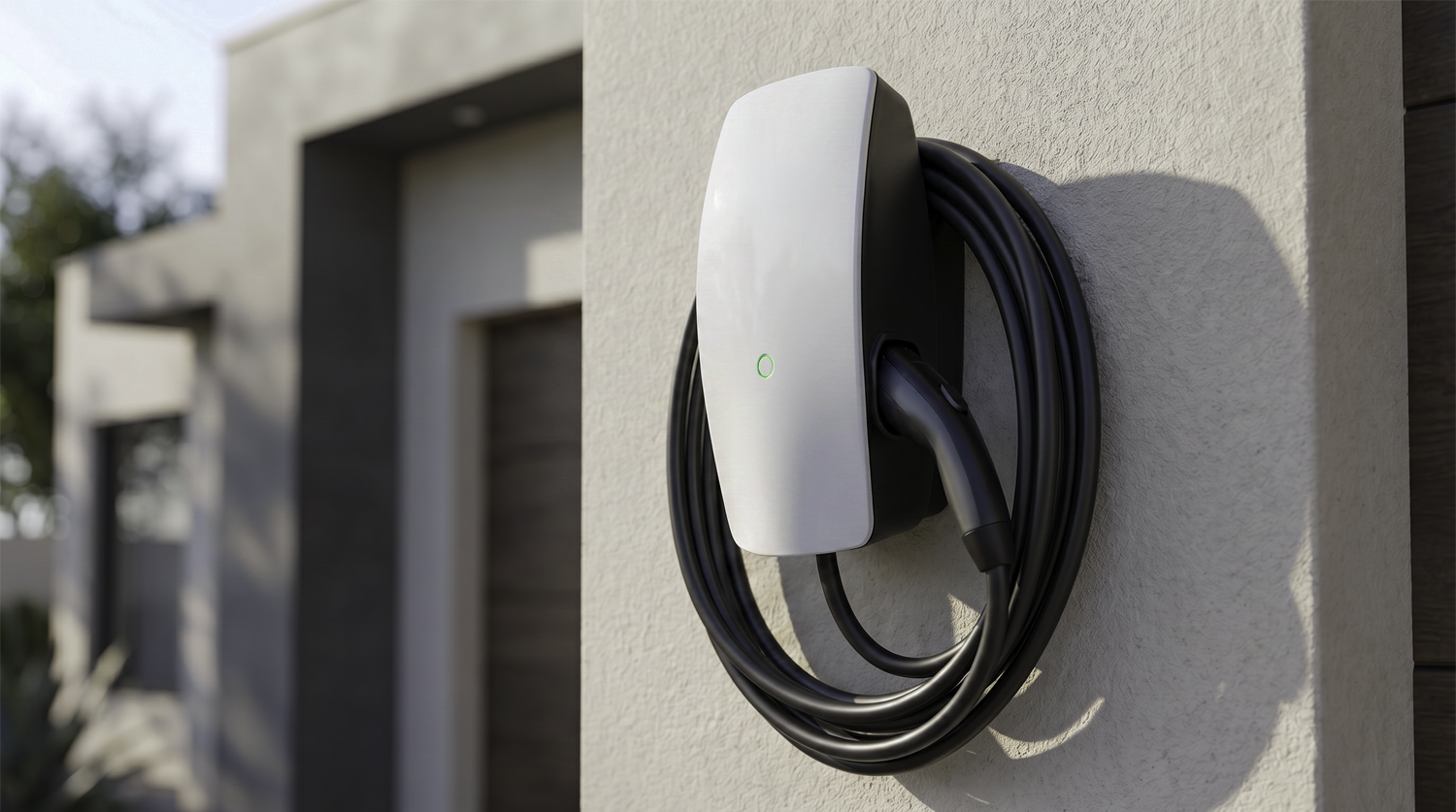
A Level 2 EV charger offers significant improvements in speed and efficiency over a Level 1 charger. Instead of using the standard 120V outlet, Level 2 charging requires a 240-volt AC electrical circuit, which is the same type of heavy-duty power source required for clothes dryers and central air conditioning units.
Level 2 charging systems operate at a higher voltage and can handle higher amperages. In simple terms, this added capacity makes the charging speed considerably faster than Level 1. The result is a net gain of up to 80 miles of range added per hour.
At Level 2 charging rates, an EV with a depleted battery can be recharged to 100% overnight or during a standard work shift. Depending on the charger and vehicle in question, you can see 0% to 100% charging cycles in as little as four hours, and no longer than 10 hours.
Level 2 EV Charger Installation Requirements
While Level 2 charging is clearly a superior experience, it has a higher barrier to entry than Level 1. A Level 2 EV charger, more precisely classified as Electric Vehicle Supply Equipment or EVSE, must either be hardwired directly into a building's electrical panel or plugged into a dedicated 240V receptacle such as a NEMA 14-50 outlet.
All this is to say that, for most consumers and businesses, you’ll need the services of a licensed electrician to install a Level 2 charger. This professional will need to evaluate your existing electrical panel to see if it can handle the required continuous high-amperage draw. In some older homes or commercial buildings, you may need an entirely new panel to accommodate a new 240V outlet.
Level 1 vs. Level 2: Key Considerations
So, is a Level 2 EV charger right for your home or business, or will Level 1 meet your needs? The answer depends on four factors: charging speed, infrastructure requirements, total costs, and how well each option fits your specific use case. The sections below break down each one.
Charging Speed
Charging speed is where the gap between Level 1 and Level 2 becomes most obvious. As noted above, a Level 1 charger only provides three to five miles of range per hour. Level 1 is strictly a trickle-charging technology that, in many use cases, is best suited for topping off a battery.
A Level 2 charger does its job substantially faster, offering anywhere from 12 to 80 miles of range per hour, depending on the EV and its onboard systems. For commercial fleet managers, faster charging time alone makes Level 2 the clear choice. A vehicle that returns to the yard at 6 pm cannot afford to still be charging at 6 am. With Level 2, that scenario is effectively eliminated.
Installation and Infrastructure Requirements
Level 1 requires no changes to your electrical infrastructure, so assuming you have the 120V outlets to spare, there are no installation costs. That is the advantage for Level 1. However, the gap between the two becomes clear once you look at what a 240V installation actually involves.
For 240V, you have to pull heavy-gauge copper wire from the breaker box to the charging station and install a dedicated high-amperage double-pole breaker. And that’s assuming your panel can accommodate it. If not, you may need to upgrade your home or commercial building’s electrical system.
Upfront Costs vs. Long-Term Efficiency
There is no doubt that Level 1 charging is cheaper when you consider only the upfront costs. Assuming you have the 120V outlets to spare and the EV came with the appropriate cable, which is true in most cases, there are basically no upfront costs for Level 1. On the other hand, Level 2 requires purchasing the charging station itself, plus the cost of materials and professional installation.
However, Level 2 is the clear winner in terms of long-term efficiency, and upfront costs may be lower than expected. The federal Alternative Fuel Vehicle Refueling Property Credit (Section 30C) currently allows homeowners and businesses to claim a tax credit for a portion of Level 2 charger installation costs. Many state governments and utility companies layer additional rebates on top of that. Before dismissing Level 2 as too expensive, it is worth checking the Database of State Incentives for Renewables and Efficiency (DSIRE) at dsire.org to see what incentives apply in your area. If your utility company offers time-of-use (TOU) rates, you can optimize this efficiency for real-world savings. For example, with TOU, you can schedule high-speed Level 2 charging during off-peak hours, such as the middle of the night, when electricity is cheapest.
Suitability for Your Use Case
Despite its trickle charging, Level 1 can work fine for many individuals. For example, a single user who works from home (and therefore drives less) typically won’t mind the longer charging cycles. If your car is a plug-in hybrid electric vehicle (PHEV) with a smaller battery, Level 1 might take less time than charging your smartphone.
But in a business setting, only Level 2 is built for the scale that commercial fleets require. Level 2 is also likely to be the only truly viable choice for pure battery-electric vehicles (BEVs) with large capacities and for multi-car households.
Ultimately, the suitability of a Level 1 vs. Level 2 EV charger comes down to unique use cases in your home or business. It’s something you have to carefully consider, along with the other three criteria discussed above.
Choosing the Right Option for Your Home
If you’re considering a home EV charging setup, here’s a process you can follow to help you make the right choice.
First, analyze your daily driving habits and charging frequency. The average American drives roughly 35 to 40 miles per day. If you drive a highly efficient EV, a Level 1 charger plugged in for 12 hours overnight might just replenish those 40 miles.
If your daily commute is relatively short and you have the patience for a full charge cycle, Level 1 might meet your needs. But if you have an average-length commute or often run errands after work, it’s unlikely Level 1 will be able to keep your EV’s battery consistently topped off. There just aren’t enough hours in the day, especially hours when your car is unavailable because it’s plugged into the wall.
Next, assess your home infrastructure, including your garage if applicable, and your overall electrical capacity. If you park on the street, dragging a Level 1 cord across a sidewalk is a major safety hazard, and a permanently mounted outdoor Level 2 unit on a driveway pedestal may be the more practical solution.
If your home has only a 100-amp electrical service, installing a 50-amp Level 2 charger might require an expensive rate upgrade from your utility provider to 200 amps.
Finally, consider your future needs. Even if Level 1 works for your current driving habits, what happens when your household acquires a second electric vehicle? Upgrading to a Level 2 EV charger now ensures your home has the bandwidth to juggle charging schedules for multiple vehicles well into the future.
Choosing the Right Option for Your Business or Fleet
If you’re considering EV charging for business use, Level 2 is the de facto minimum standard. (Level 3 and other workplace EV charging solutions are available, but are outside the scope of this discussion.) Here are a few reasons why you need at least Level 2.
Employee Charging
Many businesses now offer free EV charging in the workplace as an employee benefit. But since most employees are typically parked at work for only eight to nine hours max, Level 1 charging won’t cover the mileage for most commutes. But with Level 2, employees can plug in at 9 am and leave at 5 pm with a full charge. As simple as it sounds, this can be a compelling incentive for talent acquisition and retention.
Fleet Uptime
Commercial vehicles cannot be grounded while they wait 40 hours for a Level 1 charge. In addition to greater capacity, Level 2 smart-charging stations offer features that Level 1 simply cannot match. Wi-Fi connectivity allows remote monitoring and control through a mobile app. Scheduling tools let fleet managers set charging windows to align with off-peak utility rates. Energy monitoring dashboards track consumption per vehicle or per session. Load management distributes power intelligently across multiple vehicles to avoid tripping breakers or triggering demand charges. These capabilities make a smart Level 2 EV charger a management tool, not just a power source. Ultimately, Level 2 is the only way to ensure every fleet begins the work day with 100% readiness.
Attracting Customers
If you're in the retail business, installing public-facing Level 2 charging stations is a practical tool for customer retention. EV drivers actively seek out locations where they can charge while they shop or dine.
Offering Level 2 charging keeps customers on your premises longer, directly increasing foot traffic and potential sales.
Scalability Planning
Installing conduit and panel capacity for ten Level 2 chargers now, even if you activate only two units today, avoids costly retrofits later. As your EV fleet grows, the infrastructure will already be in place to support it without interrupting operations.
Making the Right Level 2 EV Charger Decision for Your Home or Business
Level 1 charging is the entry point, and for individual users with short commutes or work-from-home schedules, it can be a cost-free starting point. But for most homeowners, fleet managers, and business operators, the case for a Level 2 EV charger is compelling on speed, long-term efficiency, and total cost of ownership.
There are upfront costs associated with a Level 2 installation, but the long-term return on that investment is clear. Building a Level 2 infrastructure means building a smarter EV infrastructure that will deliver greater efficiency for years to come.
As EV adoption accelerates in both residential and commercial settings, demand for Level 2 infrastructure will grow alongside it. Whether you're charging a personal vehicle or managing a commercial fleet, assessing your infrastructure needs now puts you ahead of that curve. For fleet operators, pairing Level 2 charging infrastructure with a real-time GPS tracking and telematics solution like Bouncie ensures your vehicles are not only charged but fully visible and managed from a single platform.